
Before the Rohingya influx, the hills of Cox’s Bazar were full of bamboo using for betel leaf farming, cooking, and repairing homes. Then came the shelters. Almost all the reserves disappeared. And at that time, no one knew they were sitting on green gold. Today, bamboo is growing back: taller, stronger, and this time with purpose. The Bamboo for Climate Action (B4CA) Project has transformed this ordinary rural resource into one of the most powerful nature-based solutions for climate resilience, ecosystem restoration, and sustainable livelihoods. For thousands of vulnerable families, it is no longer just a plant. It is protection. It is income. It is dignity. Above all, it is hope.
Cox’s Bazar is one of Bangladesh’s most ecologically vibrant yet environmentally vulnerable regions. The land here has carried many pressures: shrinking forests, eroding slopes, saline water, cyclones, heat, and the constant need for bamboo for shelters in Refugee camps, betel leaf gardens, and household use.
It was within this reality that the Bamboo for Climate Action (B4CA) project was initiated in 5 sub districts of Cox’s Bazar: Chakaria, Cox’s Bazar Sadar, Ramu, Ukhiya and Teknaf.
Supported by SDC and implemented by CNRS in association with iDE, B4CA began with a simple but transformative belief: if bamboo is planted, protected, and connected to people’s lives, it can go beyond restoring landscapes to rebuilding confidence, livelihoods, and a green future.
That belief is already taking root. From April 2023 to March 2026, more than 1.5 million bamboo saplings have been produced through four climate-smart nurseries, of which 1 million saplings have been planted by 53,000 host and refugee community participants across homesteads, degraded forestland, canal banks, communal land, and outreach sites. These plantations now cover around 1,600 hectares of homestead land and 190 hectares of degraded forestland, with the potential to sequester 16,730 – 30788 tons of carbon. What makes this transformation even more significant is that 87% of participants are women. Women, who once had limited access to income opportunities, are now leading plantation activities, managing nurseries, participating in grower networks, and contributing directly to household resilience. Their involvement is not only strengthening local economies, but reshaping community leadership in climate action.
Unlike many timber species that require replanting after harvest, bamboo regenerates naturally when managed sustainably, producing new culms year after year. This regenerative quality makes bamboo uniquely positioned as a renewable climate solution capable of supporting both ecosystems and economies over the long term.
But the deeper story is about the people.
Every bamboo planted now carries a deeper meaning. It is a lifeline for a family rebuilding after disaster. A source of income for a rural woman entrepreneur. A renewable resource for refugee shelters. A carbon sink for a warming planet. A shield protecting vulnerable landscapes from erosion and collapse. A role in protecting their communities for the youth stewards. A symbol of resilience growing where hope is needed most. For overall Cox’s Bazar, it means reducing pressure on natural forests while building a local bamboo supply chain where demand is high and resources are scarce.
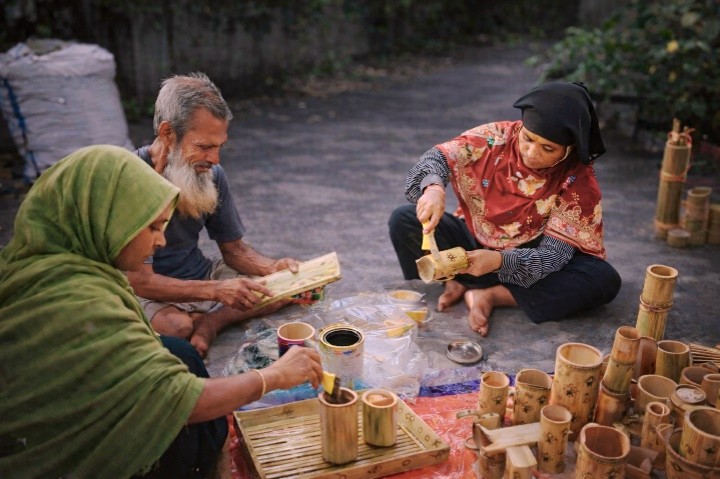
Already, plantation work has created short-term employment for more than 500 people. A growing network now connects 50,000 primary growers, 2,000 lead growers, and five upazila-level Bamboo Growers’ Associations, giving producers a collective platform for fair negotiation, market linkage, and future integration into the bamboo economy. At the same time, 200 artisans are being trained in bamboo crafts, 460 youth climate stewards are promoting sustainability and preparedness, and 600+ improved cooking stoves are helping reduce carbon emissions and fuel pressure on forests.
This is how B4CA is not just planting bamboo. It’s reshaping an ecological resource base.
| “Before, bamboo was just something we used. After the influx, there was sharp depletion. We didn’t know it could be an income. Now I am a lead grower, connected to markets, earning from bamboo culms, and sitting in village meetings where women’s voices matter. B4CA joined the dots between climate, crisis, and cash – and that has changed everything.” –Rokeya Begum, primary grower, Ukhiya |
With iDE’s market systems support, growers, artisans, entrepreneurs, associations, and buyers are being connected so that bamboo can move from household necessity to commercial opportunity through improved access to finance, joint venture agreements with (JVAs) with Social Assistance and Rehabilitation for the Physically Vulnerable (SARPV) and NRBC Bank PLC, enterprise incubation, and the mobilization of millions in co-investments. What begins as a sapling can become a shelter pole, a craft product, a source of income, a climate asset, and a reason for communities to believe in a greener future. Together, these innovations are building a dynamic ecosystem that attracts private investment, creates jobs, and positions bamboo as the cornerstone of inclusive, sustainable market development.
The movement continues to grow.
B4CA has already trained 51 private nurseries in bamboo propagation techniques and provided critical inputs to expand local production systems beyond the lifespan of the project itself. This ensures that the bamboo economy being created today can continue generating environmental and economic benefits for years to come.
In Cox’s Bazar, bamboo is no longer overlooked.
It is becoming green gold, restoring degraded forests, protecting fragile hillsides, strengthening refugee-host community resilience, and creating pathways toward sustainable livelihoods in one of the world’s most climate-vulnerable regions.
Every bamboo planted now carries a deeper meaning. It is a lifeline for a family rebuilding after disaster. A source of income for a rural woman entrepreneur. A renewable resource for refugee shelters. A carbon sink for a warming planet. A shield protecting vulnerable landscapes from erosion and collapse. A symbol of resilience growing where hope is needed most.
But this story is only beginning.
The next million bamboo could restore more degraded land, strengthen more livelihoods, expand green enterprises, and accelerate climate resilience for thousands more families across Bangladesh. For climate investors, this is a rare opportunity to join a story that is already alive. Support to B4CA means investing in visible climate action, women’s empowerment, refugee-host community resilience, ecosystem restoration, carbon benefits, and green enterprise development, all through one practical, scalable, locally grounded solution: Bamboo.
Because in Cox’s Bazar, bamboo is doing more than restoring landscapes.
It is restoring futures.